Back in September I was along (and a fleetingly brief speaker) at Brighton Bothways' event to mark Bi Visibility Day. This was a lavish affair at the city's main library, with lots of food and speakers.
They also showed a fistful of short films from YouTube about bisexuality, which were (I think) all from the USA due to the lack of good bi short films from the UK suitable for such an event. Partly to help start changing that, and partly to document the Brighton event itself, I filmed several of the speakers on the night and have since had to learn a few tricks to get the best out of the footage.
Four of those people have now given their permission for us to use the videos I made so here are four short clips of people talking about being bi in Brighton and the UK. I do hope you enjoy them.
Klara talks about growing up bisexual:
Arwen reads a poem she wrote about being bi:
Andi from the local council's LGBT workers forum:
Jak talks about growing up bi:
Wednesday, 14 November 2012

Sunday, 21 October 2012
Creatively wrong
I've come across lots of interesting redefinitions of bi and definition pairs of bi and pan before. However - and I can't give you the link as it's one of the million web pages I've read this weekend - this weekend I came across a genius new one. I paraphrase mildly as I read it a short while ago...
Bi is if you have sexual relationships with any gender, pan is if they are romantic relationship
Wow. How brilliantly creative is that? There are these two words, right, and we know that 'bi' is the untrendy one that means you're not in with the cool crowd, but they seem to mean the same damn thing... it must be possible to come up with some kind of definition that splits them apart!
These kind of "bi is not the same" definitions always seem to involve pan being somehow morally superior. I think that might be the tell that gives away an attempt to make yourself more acceptable, the sad old theme of putting another group or identity down in order to raise yourself up in the social rankings.
Bi is if you have sexual relationships with any gender, pan is if they are romantic relationship
Wow. How brilliantly creative is that? There are these two words, right, and we know that 'bi' is the untrendy one that means you're not in with the cool crowd, but they seem to mean the same damn thing... it must be possible to come up with some kind of definition that splits them apart!
These kind of "bi is not the same" definitions always seem to involve pan being somehow morally superior. I think that might be the tell that gives away an attempt to make yourself more acceptable, the sad old theme of putting another group or identity down in order to raise yourself up in the social rankings.
Bye bye Pink Paper
The Pink Paper has closed down.
The Pink meant a lot to me: when I first came out onto the LGBT scene, there it was: a tabloid sized newspaper, free and available in big piles in bars, in the foyer of the students union, on a display rack in the library ten miles away when I needed a lifeline to the real world in university holidays. It started publishing a few years before I came out, at what became a crucial time in queer politics when shortly after its launch the Conservatives unveiled 'Section 28', the Labour-endorsed law which sought to wipe out homosexuality by making the mention of its existence illegal.
So a campaigning national weekly free newspaper must have been a shot in the arm for the mobilising queer campaigners (all the talk of the era is that it was 'lesbians and gays' but I am sure there would have been a good fistful of bis and transfolk and allies in the campaign too).
Bankrolled, as I understand it, largely by its more advertiser-friendly sister paper Boyz, the Pink was worthy, communityish and newsy.
It wasn't always the friend of the bi reader. From its aversion to admitting to the b word in editorial (one that stuck with me was a caption that said "[name] who described herself as bisexual, [at some do or other]", a contortion of words that would never have been used about a gay person) to its personal ads pages with a plethora of lonely hearts wanting a GSOH but "no bisexuals". Looking back, 'no bisexuals' was one of the few requirements in lonely hearts ads in the Pink Paper that never got turned into an abbreviation: you wouldn't want one to slip through the net saying they thought NB meant Nice Bum. But until you got deep enough into the community to find out about BiFrost or BCN, it was the queer press you could find - and it was every week, not every month or three.
I'm told it highlighted the commitments of each party to lesbian and gay (yes...) rights at one general election with a front page quoting the three manifestos' commitments to the gay community. Each got equal space: a third of the page was full of text from the Liberal manifesto; one third was blank bar a paragraph for Labour; the third column had nothing to spoil its emptiness.
Some time in the 90s, presumably as income from 08x premium rate chatline ads waned, there was a brief relaunch as a paid-for A4 magazine. They knew they had oodles of readers who read the paper every week, surely as a nicer-looking magazine it would fly off the shelves? It was an enormous flop, and the publishers beat a hasty retreat with a re-relaunch as a free A4 magazine soon afterwards.
The Pink had annual readers awards, in a growing list of categories (think "best redheaded barmaid in a lesbian bar in East Anglia goes to...") and a few times I took it upon myself to try and rock the vote to get the bisexual community noticed in the Pink. When it worked, that got BiCon listed as one of the five best queer events of the year two years running - once coming third ahead of Glastonbury and London Pride. Manchester's BiPhoria took fifth place in best LGBT community group too.
As the web appeared in every home and every pocket, the Pink Paper's time as a print title came to an end. I still have half-a-dozen or more old issues knocking about my home, and when I pull them down from the shelf they are fond reminders of a harder time, charting the progress of LGBT rights as the news becomes less sharply political as the locus of political debate became less sharply hostile, bringing memories of long-lost friends and dancing til dawn, of who I was dating or of aching for that first lover to come into my life. It's a sensual thing: you won't ever get that with browsing an old web page.
The Pink Paper was at times frustrating, on good days it gave a warm nod to bisexuality on page 17 and on bad days it erased us out of all existence; but then we would all run things a little differently if it was our own choice. In its time it was a force for good, and among all the "no bisexuals" notes in the personal ads there were a host of TLAs that taught me a lot about the dos and donts of dating. Bye bye Pink. Thank you for having been there.
The Pink meant a lot to me: when I first came out onto the LGBT scene, there it was: a tabloid sized newspaper, free and available in big piles in bars, in the foyer of the students union, on a display rack in the library ten miles away when I needed a lifeline to the real world in university holidays. It started publishing a few years before I came out, at what became a crucial time in queer politics when shortly after its launch the Conservatives unveiled 'Section 28', the Labour-endorsed law which sought to wipe out homosexuality by making the mention of its existence illegal.
So a campaigning national weekly free newspaper must have been a shot in the arm for the mobilising queer campaigners (all the talk of the era is that it was 'lesbians and gays' but I am sure there would have been a good fistful of bis and transfolk and allies in the campaign too).
Bankrolled, as I understand it, largely by its more advertiser-friendly sister paper Boyz, the Pink was worthy, communityish and newsy.
It wasn't always the friend of the bi reader. From its aversion to admitting to the b word in editorial (one that stuck with me was a caption that said "[name] who described herself as bisexual, [at some do or other]", a contortion of words that would never have been used about a gay person) to its personal ads pages with a plethora of lonely hearts wanting a GSOH but "no bisexuals". Looking back, 'no bisexuals' was one of the few requirements in lonely hearts ads in the Pink Paper that never got turned into an abbreviation: you wouldn't want one to slip through the net saying they thought NB meant Nice Bum. But until you got deep enough into the community to find out about BiFrost or BCN, it was the queer press you could find - and it was every week, not every month or three.
I'm told it highlighted the commitments of each party to lesbian and gay (yes...) rights at one general election with a front page quoting the three manifestos' commitments to the gay community. Each got equal space: a third of the page was full of text from the Liberal manifesto; one third was blank bar a paragraph for Labour; the third column had nothing to spoil its emptiness.
Some time in the 90s, presumably as income from 08x premium rate chatline ads waned, there was a brief relaunch as a paid-for A4 magazine. They knew they had oodles of readers who read the paper every week, surely as a nicer-looking magazine it would fly off the shelves? It was an enormous flop, and the publishers beat a hasty retreat with a re-relaunch as a free A4 magazine soon afterwards.
The Pink had annual readers awards, in a growing list of categories (think "best redheaded barmaid in a lesbian bar in East Anglia goes to...") and a few times I took it upon myself to try and rock the vote to get the bisexual community noticed in the Pink. When it worked, that got BiCon listed as one of the five best queer events of the year two years running - once coming third ahead of Glastonbury and London Pride. Manchester's BiPhoria took fifth place in best LGBT community group too.
As the web appeared in every home and every pocket, the Pink Paper's time as a print title came to an end. I still have half-a-dozen or more old issues knocking about my home, and when I pull them down from the shelf they are fond reminders of a harder time, charting the progress of LGBT rights as the news becomes less sharply political as the locus of political debate became less sharply hostile, bringing memories of long-lost friends and dancing til dawn, of who I was dating or of aching for that first lover to come into my life. It's a sensual thing: you won't ever get that with browsing an old web page.
The Pink Paper was at times frustrating, on good days it gave a warm nod to bisexuality on page 17 and on bad days it erased us out of all existence; but then we would all run things a little differently if it was our own choice. In its time it was a force for good, and among all the "no bisexuals" notes in the personal ads there were a host of TLAs that taught me a lot about the dos and donts of dating. Bye bye Pink. Thank you for having been there.
Saturday, 20 October 2012
A happy little grump

So the back cover got a full-page and colourful advert for the day, seeking to encourage people to come up with plans and share them with a "what will you be doing?" tagline.
It worked a treat. Well, to be fair the momentum's been building for years - this was a helpful nudge at the right time.
What was intriguing though was that the advert took off - I keep finding it (see image) on things around the world, usually like this with the september23 URL frustratingly clipped off. Facebook, blogs, the Advocate and more.
It's pleasing to see it being used all over the place. It'd be nice if more places credited it to BCN though.
Wednesday, 3 October 2012
Bi Women article
I wrote a little something for Boston's bi magazine Bi Women. As the issue is now out and online as a pdf for people to read it seems fair to crosspost it here too. I've not tried to write for an overseas audience before... for a UKanian audience I'd've used phrases like Yes Prime Minister.
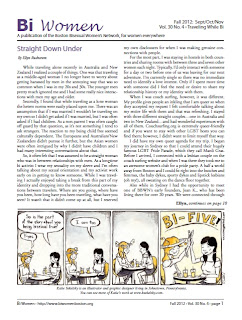 Meanwhile, from “across the pond” in the UK...
A Downing Street Bi Breakthrough
By Jen Yockney
On July 24th I had the unexpected honor of being the first person invited to represent the bi community at the annual LGBT Garden Party held by UK Prime Minister David Cameron.
A few days earlier I had received an unexpected note: “The Prime Minister Requests The Pleasure Of Your Company.” Well, if he was putting it like that who was I to say no? So to London and to Downing Street. First you meet charming yet obviously armed police at the entrance to Downing Street who check your passport and check if your name is on their list. You pass through scanners and suddenly you’re past the security point and stepping onto one of the most filmed places in England, normally the preserve of senior ministers and visiting dignitaries. On the TV it looks like a grand sweeping arch of space but it’s a surprisingly small road: they must keep the TV cameras on wide-angle lenses to get the feeling of space.
In through the door of Number 10 (and as a politics geek from a young age, you cannot imagine how hard it is not to bounce off the walls with excitement) and Number 10 staff direct you along corridors lined with portraits of premiers past, down stairs and into the garden of the Prime Minister.
Cue endless canapes and staff making sure your glass stays topped-up; I was wise to go for the fruit juice as I might have had to be carried out if I’d drunk that much wine. There was about an hour of milling about, meeting and talking with around 100 other people from around the UK who do fantastic things in other parts of the LGBT community. As a bisexual genderqueer woman it was good to spot a couple of familiar bi faces and a couple of familiar trans faces; they were invited for non “bi activist” briefs though. There were many religious figures, all of Britain’s senior out-LGBT clergy: the theme of this year’s gathering being the UK government’s plans to legislate for same-sex marriage.
And then here’s Cameron. He speaks for about ten minutes off the cuff, praising the work of many in the crowd, and talks about “gay marriage” and how he thinks the churches are making a big mistake in opposing it. For US readers, imagine a Republican President condemning the church for not supporting same-sex marriage and saying his party had been wrong to be against LGBT equality in the past. He may not be word-perfect on his queer terminology, but this is a man elected seven years ago on an anti-gay rights ticket, so it is great to hear him having come so far in that time.
Then more drinks and mingling and—about 45 minutes after the official end time—the Downing Street staff usher us out. Of course being outside Number 10 means spending half an hour on the doorstep taking photos of one another. This time there was just me; a great honor to be the first, but the UK has many brilliant and vibrant bi projects: BiUK, Bisexual Index, BiPhoria and more. I do hope next year there are three or four of us.
So that was my 39th birthday. I’m a little worried how to top it for my 40th next year!
Jen is the editor of the UK magazine, Bi Community News and has been a bi activist for a very long time

A Downing Street Bi Breakthrough
By Jen Yockney
On July 24th I had the unexpected honor of being the first person invited to represent the bi community at the annual LGBT Garden Party held by UK Prime Minister David Cameron.
A few days earlier I had received an unexpected note: “The Prime Minister Requests The Pleasure Of Your Company.” Well, if he was putting it like that who was I to say no? So to London and to Downing Street. First you meet charming yet obviously armed police at the entrance to Downing Street who check your passport and check if your name is on their list. You pass through scanners and suddenly you’re past the security point and stepping onto one of the most filmed places in England, normally the preserve of senior ministers and visiting dignitaries. On the TV it looks like a grand sweeping arch of space but it’s a surprisingly small road: they must keep the TV cameras on wide-angle lenses to get the feeling of space.
In through the door of Number 10 (and as a politics geek from a young age, you cannot imagine how hard it is not to bounce off the walls with excitement) and Number 10 staff direct you along corridors lined with portraits of premiers past, down stairs and into the garden of the Prime Minister.
Cue endless canapes and staff making sure your glass stays topped-up; I was wise to go for the fruit juice as I might have had to be carried out if I’d drunk that much wine. There was about an hour of milling about, meeting and talking with around 100 other people from around the UK who do fantastic things in other parts of the LGBT community. As a bisexual genderqueer woman it was good to spot a couple of familiar bi faces and a couple of familiar trans faces; they were invited for non “bi activist” briefs though. There were many religious figures, all of Britain’s senior out-LGBT clergy: the theme of this year’s gathering being the UK government’s plans to legislate for same-sex marriage.
And then here’s Cameron. He speaks for about ten minutes off the cuff, praising the work of many in the crowd, and talks about “gay marriage” and how he thinks the churches are making a big mistake in opposing it. For US readers, imagine a Republican President condemning the church for not supporting same-sex marriage and saying his party had been wrong to be against LGBT equality in the past. He may not be word-perfect on his queer terminology, but this is a man elected seven years ago on an anti-gay rights ticket, so it is great to hear him having come so far in that time.
Then more drinks and mingling and—about 45 minutes after the official end time—the Downing Street staff usher us out. Of course being outside Number 10 means spending half an hour on the doorstep taking photos of one another. This time there was just me; a great honor to be the first, but the UK has many brilliant and vibrant bi projects: BiUK, Bisexual Index, BiPhoria and more. I do hope next year there are three or four of us.
So that was my 39th birthday. I’m a little worried how to top it for my 40th next year!
Jen is the editor of the UK magazine, Bi Community News and has been a bi activist for a very long time
Friday, 28 September 2012
'Boss' kept in his place?
This one is barely a blogpost, just an incredulous note.
Mark Pack writes here that Labour bosses responded to Ed Miliband's swapping of occasional texts with Vince Cable by confiscating his mobile phone.
I'm not the most butch and assertive person in the world, but really, if I were leader of Her Majesty's Opposition, I like to think I'd be bold enough to say "Who'sQueen Leader?" when one of my underlings tried that kind of a trick.
Maybe they used a magic word that Ed's obliged to obey, in a 'Simon Says' kind of a way. TUC says hand over your phone.
Mark Pack writes here that Labour bosses responded to Ed Miliband's swapping of occasional texts with Vince Cable by confiscating his mobile phone.
I'm not the most butch and assertive person in the world, but really, if I were leader of Her Majesty's Opposition, I like to think I'd be bold enough to say "Who's
Maybe they used a magic word that Ed's obliged to obey, in a 'Simon Says' kind of a way. TUC says hand over your phone.
Monday, 3 September 2012
18 years of BiPhoria!
As published recently in Bi Community News under the headline "Manchester's 18". A few reflections on the story of eighteen years of a local bi social & support group; it would have been more navel-gazing and reflective without the word limit on the article!
BiPhoria emerged, like so many bi groups, from Manchester bis meeting up at BiCon and getting talking, and deciding they wanted a bi group back home. There were already bi groups in the city - one for men, one for women. However it seems the penny dropped that meeting in separate groups when the uniting factor was that you were people for whom gender was less of an issue was a little peculiar. At the very least there was room to get together as well.
The model used took organising ahead of each group meeting: every month’s meeting had a defined topic with workshops planned out for months ahead. That seems to have been the case with most other bi groups at the time.
The group started out meeting at Manchester's Lesbian & Gay Centre on Sidney Street. It was a good central location close to bus and train routes, and familiar to people attending the men’s or women’s bi groups.
The first few years were quite energetic, as seems to often be the case where a new bi group forms in an area with pent-up demand. The monthly calendar had clubbing nights, cinema trips, a bi hill-walking group and more. Among the spin-off projects was one to lobby the city council, whose equality policies and monitoring firmly declared everyone to be either gay or straight, and to challenge the “no bisexuals” door policies of several gay venues in the city in the 90s.
But after a time early impetus dies out, people find their lives are taking them elsewhere and in the odd case the realisation that you don’t get paid for running this puts people off too. Planning meetings saw a diminishing pool of people willing to run the group. This was a crunch point - I wound up running the group and if I’d stepped away too there would have been no volunteer base left.
Groups have momentum and this downward arc continued; for about six months we had typically 3 people a month to meetings, where the group would consist of me, someone who had last been to the group a year or two earlier asking “where is everyone?” and a new member who would never come back on the grounds that it clearly wasn’t the place to meet bi folk after all. It is hard work summoning up the energy to go back again each month at times like that. But the steady grind of small publicity work (flyers and posters) and luck of the draw meant eventually breaking out of the cycle - you get a month where four ‘occasional’ members and two or three new people means the mood in the room changes and things start to grow back up from there.
This slow build included bidding for the 2000 BiCon to come to the city. For years BiCon had moved around the country from year to year without ever landing in Manchester. This turned into a bit of a joke - with Queer As Folk all over the TV, that Manchester was too busy partying the night away to host a BiCon. The team were mostly not part of the group though: hosting BiCon 1998 had torn apart the Cambridge group, and Manchester wasn’t strong enough to face that kind of stress.
While all eyes were on BiCon there were changes afoot: the city's Lesbian & Gay Switchboard and gay men's sexual health project HGM were merging, and once again the dilapidated Sidney Street building was under threat of closure. Most groups meeting at Sidney Street merged into this new Lesbian & Gay Foundation, but BiPhoria stayed at arm’s length, meeting in the new LGF building but remaining independent.
This meant finding funding: previously group costs were met by a quick whip-round at each meeting and room hire was free. Now room hire cost £30 a time so some of the energy that would have gone into group work had to go into funding bids and accounting to these. But that also meant a greater engagement with other LGBT groups in the city, and a slightly higher profile.
That profile and more members getting involved again with organising aspects of the group’s work meant the tide was now flowing with the group; we had day-long events to mark Bi Visibility Day in 2001 and 2002, were drawn into the city’s Local Strategic Partnership work and in 2003 published a research report on bi needs in the city based on funded qualitative interviews. The shape of group meetings changed, with a three-stage evening that starts with half an hour new members’ induction, 90 minutes of discussion normally without a pre-assigned subject, and then adjourning to a nearby quiet pub for chatter over drinks.
Another BiCon in 2004 was our last big blow-out, since when there have been small to mid size events each year - a BiFest or something to mark LGBT History Month - and things have balanced out with structured group meetings and pub / cafe meets. We’ve had a consistent profile elsewhere too at local LGBT conferences and at Prides in our wider catchment area (which goes right up to Carlisle!) - something that can only happen with enough volunteers making time in their lives to do that outreach and visibility. In the end the local council even admitted bisexuals exist.
And here we are 18 years on, inheriting along the way the mantle of the oldest bi group in the country as other groups from the early 90s have folded. Join us to celebrate our 18th birthday downstairs at Taurus, 1 Canal St on September 1st (from 3pm). Bring cake!
BiPhoria emerged, like so many bi groups, from Manchester bis meeting up at BiCon and getting talking, and deciding they wanted a bi group back home. There were already bi groups in the city - one for men, one for women. However it seems the penny dropped that meeting in separate groups when the uniting factor was that you were people for whom gender was less of an issue was a little peculiar. At the very least there was room to get together as well.
The model used took organising ahead of each group meeting: every month’s meeting had a defined topic with workshops planned out for months ahead. That seems to have been the case with most other bi groups at the time.
The group started out meeting at Manchester's Lesbian & Gay Centre on Sidney Street. It was a good central location close to bus and train routes, and familiar to people attending the men’s or women’s bi groups.
The first few years were quite energetic, as seems to often be the case where a new bi group forms in an area with pent-up demand. The monthly calendar had clubbing nights, cinema trips, a bi hill-walking group and more. Among the spin-off projects was one to lobby the city council, whose equality policies and monitoring firmly declared everyone to be either gay or straight, and to challenge the “no bisexuals” door policies of several gay venues in the city in the 90s.
But after a time early impetus dies out, people find their lives are taking them elsewhere and in the odd case the realisation that you don’t get paid for running this puts people off too. Planning meetings saw a diminishing pool of people willing to run the group. This was a crunch point - I wound up running the group and if I’d stepped away too there would have been no volunteer base left.
Groups have momentum and this downward arc continued; for about six months we had typically 3 people a month to meetings, where the group would consist of me, someone who had last been to the group a year or two earlier asking “where is everyone?” and a new member who would never come back on the grounds that it clearly wasn’t the place to meet bi folk after all. It is hard work summoning up the energy to go back again each month at times like that. But the steady grind of small publicity work (flyers and posters) and luck of the draw meant eventually breaking out of the cycle - you get a month where four ‘occasional’ members and two or three new people means the mood in the room changes and things start to grow back up from there.
This slow build included bidding for the 2000 BiCon to come to the city. For years BiCon had moved around the country from year to year without ever landing in Manchester. This turned into a bit of a joke - with Queer As Folk all over the TV, that Manchester was too busy partying the night away to host a BiCon. The team were mostly not part of the group though: hosting BiCon 1998 had torn apart the Cambridge group, and Manchester wasn’t strong enough to face that kind of stress.
While all eyes were on BiCon there were changes afoot: the city's Lesbian & Gay Switchboard and gay men's sexual health project HGM were merging, and once again the dilapidated Sidney Street building was under threat of closure. Most groups meeting at Sidney Street merged into this new Lesbian & Gay Foundation, but BiPhoria stayed at arm’s length, meeting in the new LGF building but remaining independent.
This meant finding funding: previously group costs were met by a quick whip-round at each meeting and room hire was free. Now room hire cost £30 a time so some of the energy that would have gone into group work had to go into funding bids and accounting to these. But that also meant a greater engagement with other LGBT groups in the city, and a slightly higher profile.
That profile and more members getting involved again with organising aspects of the group’s work meant the tide was now flowing with the group; we had day-long events to mark Bi Visibility Day in 2001 and 2002, were drawn into the city’s Local Strategic Partnership work and in 2003 published a research report on bi needs in the city based on funded qualitative interviews. The shape of group meetings changed, with a three-stage evening that starts with half an hour new members’ induction, 90 minutes of discussion normally without a pre-assigned subject, and then adjourning to a nearby quiet pub for chatter over drinks.
Another BiCon in 2004 was our last big blow-out, since when there have been small to mid size events each year - a BiFest or something to mark LGBT History Month - and things have balanced out with structured group meetings and pub / cafe meets. We’ve had a consistent profile elsewhere too at local LGBT conferences and at Prides in our wider catchment area (which goes right up to Carlisle!) - something that can only happen with enough volunteers making time in their lives to do that outreach and visibility. In the end the local council even admitted bisexuals exist.
And here we are 18 years on, inheriting along the way the mantle of the oldest bi group in the country as other groups from the early 90s have folded. Join us to celebrate our 18th birthday downstairs at Taurus, 1 Canal St on September 1st (from 3pm). Bring cake!
Binary Greens
Some confused people and some biphobic people like to throw around the idea that the "bi" in bisexual means that bisexuality props up binary thinking.
This is of course delicious piffle and has been taken apart for the oblox it is many times, though being an internet story it re-emerges frequently, just like the imaginary £6bn Vodafone are supposed to have stashed down the back of the sofa or Barclays' 1% tax bill.
Today's news has a proper example of binary thinking though. The Green Party have elected a new leader and deputy leader. One has to be male, the other female; there is inevitable outrage as this meant a low-polling male candidate for deputy leader was elected in preference to more popular female candidates.
One male, one female. Neatly keeping intersex and genderqueer people away from the levers of power in your organisation?
Now that's what I call propping up a gender binary.
This is of course delicious piffle and has been taken apart for the oblox it is many times, though being an internet story it re-emerges frequently, just like the imaginary £6bn Vodafone are supposed to have stashed down the back of the sofa or Barclays' 1% tax bill.
Today's news has a proper example of binary thinking though. The Green Party have elected a new leader and deputy leader. One has to be male, the other female; there is inevitable outrage as this meant a low-polling male candidate for deputy leader was elected in preference to more popular female candidates.
One male, one female. Neatly keeping intersex and genderqueer people away from the levers of power in your organisation?
Now that's what I call propping up a gender binary.
Subscribe to:
Posts (Atom)